Window Signage for Retail: A Complete Guide to Types, Design, and Installation
Your storefront windows face the street every day — every person who walks or drives by sees them, whether they mean to or not. Window signage is one of the most cost-effective forms of advertising a brick-and-mortar business can invest in, and it never stops working. This guide covers every window signage type available, how to design for glass, and what to expect from installation.
Window signage works 24 hours a day, 7 days a week, with no recurring cost. A single well-designed window graphic pays for itself many times over across its 3–7 year lifespan.
Window Signage Types — Which One Do You Need?
| Type | Best Use Case | Removable? | Lifespan |
|---|---|---|---|
| Cut Vinyl Lettering | Hours, phone number, business name — clean and classic | Yes (with heat) | 5–7 years |
| Printed Window Decals | Logos, illustrations, full-color graphics on glass | Yes | 3–5 years exterior |
| Perforated One-Way Vision Film | Large window coverage — see-through from inside | Yes | 2–4 years |
| Frosted / Etched Vinyl | Privacy, branding, decorative patterns on glass | Yes | 5–7 years |
| Static Cling Decals | Seasonal promotions, limited-time offers | Yes — reusable | 1–2 years |
| Full Window Wraps | Maximum visual impact, full coverage branding | Yes (professional) | 3–5 years |
Cut Vinyl Lettering
Cut vinyl is the most timeless window signage format. A single color of vinyl is die-cut into letters, logos, or shapes and applied directly to the glass. It reads cleanly from distance, looks professional in any setting, and lasts for years. It's the right choice for business hours, phone numbers, website URLs, and simple logos that work in one color.
Cut vinyl is available in dozens of standard colors including white, black, gold, silver, and a full range of opaque and translucent options. It can be applied to the interior or exterior surface of the glass.
Interior vs. Exterior Application
Interior-applied vinyl is protected from weather and UV degradation — it lasts significantly longer. Exterior application is easier to read (no glass glare between viewer and graphic) and works better for designs that need high visibility. For most lettering, interior application is preferred for longevity.
Perforated One-Way Vision Film
Perforated vinyl is a unique product — from outside the building, it reads as a solid, full-color graphic. From inside, it's nearly transparent, maintaining your view outward. The film is printed with tiny holes (typically 50% hole pattern) that allow light to pass through from inside to out.
One-way vision is ideal for large window coverage — retail storefronts, restaurant windows, and vehicle rear windows. It provides both privacy and branding in one material. Because it covers significant glass area, it must be installed on the exterior surface to achieve the one-way effect.
One-way vision works best in high ambient light conditions outside. At night, when interior light is brighter than exterior, the effect can reverse — interior occupants become more visible. This is worth considering for restaurants and businesses open after dark.
Frosted and Etched Vinyl
Frosted vinyl replicates the look of acid-etched or sandblasted glass at a fraction of the cost and without permanent modification to the glass. It's translucent — light passes through — but obscures the view, making it ideal for privacy applications in offices, medical facilities, conference rooms, and retail fitting rooms.
It can be applied as a solid field, cut into patterns and letterforms, or printed as full-color frosted graphics. A popular technique is frosted vinyl with clear cut-out lettering — the letters appear as clear glass surrounded by frosted film, creating an elegant etched-glass effect.
Designing Window Graphics That Work
Design for High Contrast
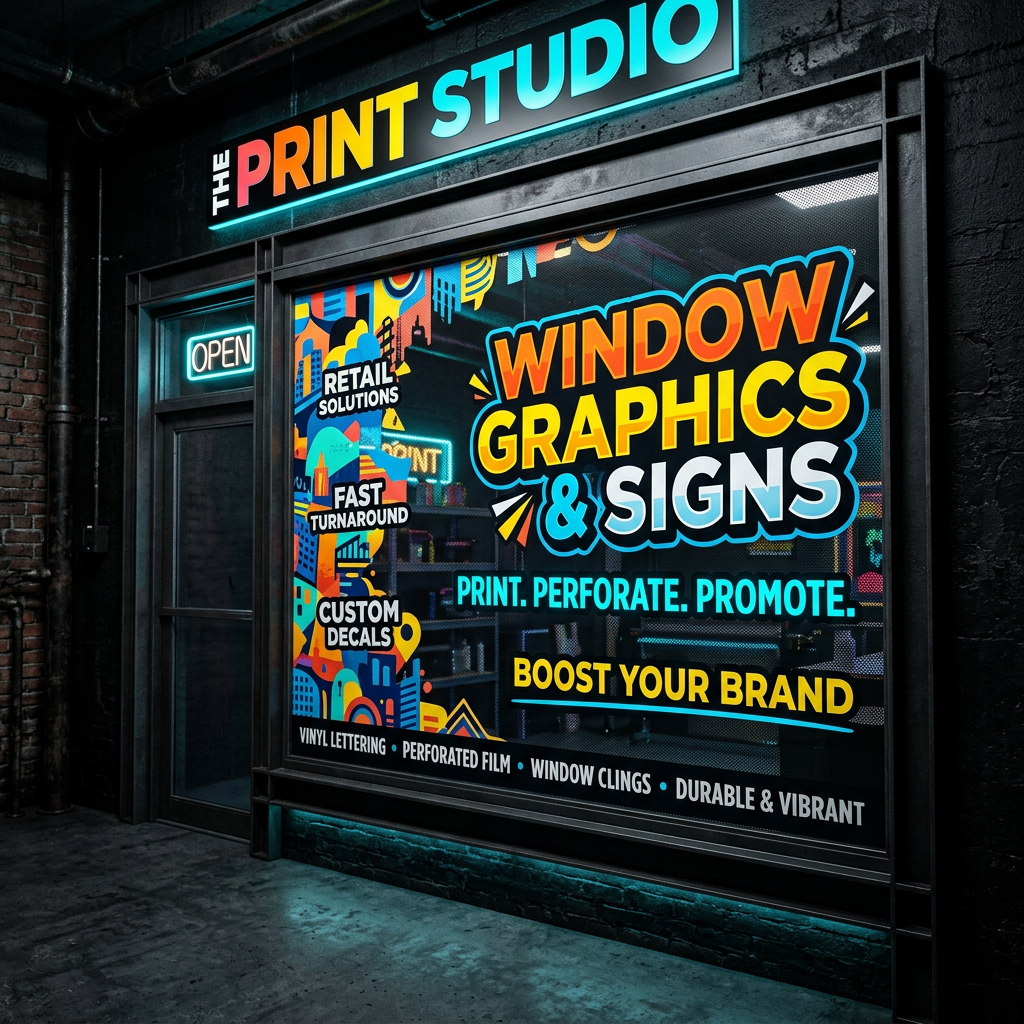
Window glass creates a reflective surface that can wash out low-contrast graphics — especially in bright daylight. Use bold, high-contrast designs: white or light-colored graphics on dark windows, or dark graphics against light interior backgrounds. Test your design by viewing it against both a light and dark background before finalizing.
Respect the Viewing Distance
Lettering on a storefront window is typically read from 10–30 feet away, often from a moving vehicle. A general rule: for every 10 feet of viewing distance, text should be at least 1 inch tall (at the point size that represents its printed height). Business names and headlines should be much larger — 6 to 12 inches tall for street-facing windows.
Keep Windows Partially Open
A fully covered window blocks natural light and can feel unwelcoming from inside. As a general guideline, leave at least 40–50% of your total window area clear — use graphics strategically around the perimeter, as border elements, or in the lower portion of the glass where it's below sightline from inside.
Coordinate With Your Other Brand Materials
Your window graphics should feel like they belong to the same family as your business cards, signage, and interior materials. Use the same fonts, colors, and logo treatment. Inconsistency between your window graphics and your other branding creates a disjointed impression that subtly undermines trust.
File Setup for Window Graphics
| Spec | Requirement |
|---|---|
| Color Mode | CMYK — convert from RGB before sending |
| Resolution | 150 dpi at full size for large graphics, 300 dpi for small decals |
| Bleed | 0.25" on all sides |
| Format | Print-ready PDF or Adobe Illustrator (embedded fonts, linked images) |
| Cut Lines | Provide on a separate layer for die-cut shapes |
| Transparent Areas | Indicate clearly — especially for perforated and frosted vinyl |
How Long Does Window Signage Last?
Lifespan depends heavily on sun exposure, installation surface (interior vs. exterior), and material grade. UV laminate adds 1–3 years to any exterior graphic. Cast vinyl outlasts calendered vinyl significantly in high-heat conditions — relevant for south- and west-facing windows in South Florida.
South Florida Heat Note
In Broward County, south and west-facing window graphics are exposed to intense UV radiation year-round. For exterior-applied graphics on sun-facing windows, always request cast vinyl with UV laminate — the cost difference is modest but the lifespan difference is dramatic.
Can I Install Window Signage Myself?
Small cut vinyl lettering and individual decals under 24 inches can be installed by most business owners with the right preparation and technique — see our vinyl application guide for step-by-step instructions. Large-format graphics, full window wraps, and perforated film over large areas benefit from professional installation to avoid bubbles, misalignment, and wasted material.
Ready to transform your storefront? We produce all types of window graphics and offer professional installation throughout Broward County. Send us your window dimensions and we'll send you a quote within one business day.
Ready to Print?
Submit your files and we'll take it from here.

